
Work Health & Safety

Your safety is not negotiable

TheFCA operates professional training kitchens, hospitality venues, and industry placement environments. These are real workplaces — with sharp equipment, hot surfaces, heavy loads, pressured service conditions, and the full physical and psychological demands of a working hospitality career. Safety in these environments is not a formality. It is a professional standard, and at TheFCA it is treated as one from your very first day.
Understanding your rights and responsibilities under Work Health and Safety law is also part of your qualification. The industry you are training to enter expects its people to work safely, identify hazards, and respond appropriately. What you learn here, you carry with you into every kitchen and venue you work in for the rest of your career.
The legal framework
Work Health and Safety in Australia is governed by the Work Health and Safety Act 2011 (WHS Act) and its associated Regulations and Codes of Practice. Victoria operates under the Occupational Health and Safety Act 2004 (OHS Act) and the Occupational Health and Safety Regulations 2017, which set out the same fundamental obligations.

Under this framework:
- TheFCA, as a person conducting a business or undertaking (PCBU), has a primary duty of care to ensure the health, safety, and welfare of all workers and other persons — including students — so far as is reasonably practicable.
- Students at TheFCA are regarded as workers for the purposes of WHS/OHS obligations when engaged in training activities on TheFCA premises and during industry placement. This means you are both protected by and subject to the same obligations that apply to paid employees in equivalent workplaces.
- Industry placement host venues are also PCBUs with their own duty of care to you as a worker present at their premises. TheFCA maintains a formal agreement with each placement partner regarding shared WHS responsibilities.
Responsibilities
TheFCA's responsibilities to you
Providing and maintaining a physical training environment that is safe and without risks to health, including kitchens, workstations, equipment, and common areas.
Ensuring that all equipment used in training is fit for purpose, regularly inspected, correctly maintained, and operated under appropriate supervision.
Providing clear safety instructions, inductions, and training before students begin practical work involving hazards.
Identifying hazards in the training environment, assessing associated risks, and implementing controls to eliminate or minimise those risks so far as is reasonably practicable.
Maintaining systems for reporting, recording, and responding to incidents, near-misses, injuries, and hazards.
Ensuring that student-to-trainer ratios in practical sessions are appropriate for the activity and level of hazard involved.
Providing access to first aid facilities, trained first aid officers, and emergency response procedures at all TheFCA premises.
Consulting with students on matters that affect their health and safety in the training environment.
Maintaining records of WHS incidents and using them to continuously improve safety practices.
Your responsibilities as a student
Under WHS law, you have legally enforceable responsibilities as a worker in your training environment. These are not discretionary. They exist regardless of whether you are a full-time student, an international student, or a student on placement.
Take reasonable care for your own health and safety, and for the health and safety of others who may be affected by your actions or omissions.
Follow all safety instructions provided by your trainers, assessors, and placement supervisors.
Use personal protective equipment (PPE) correctly and as directed — including wearing your uniform, non-slip safety footwear, and any other required protective items during practical sessions.
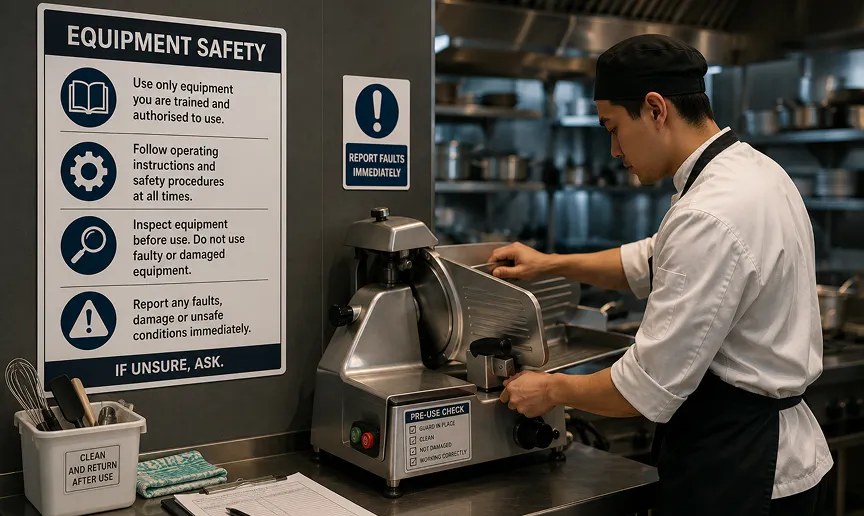
Not operate equipment you have not been trained and cleared to use.
Not undertake a task you believe is unsafe. If you are uncertain, stop and ask.
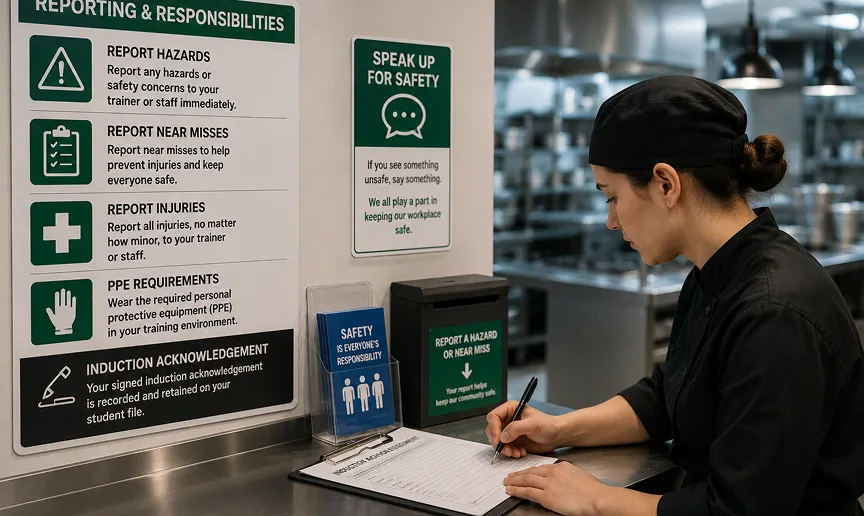
Report hazards, near-misses, and injuries to your trainer or supervisor immediately, regardless of how minor they appear.
Not engage in behaviour that places yourself or others at risk, including horseplay, distraction, or misuse of equipment.
Attend and actively participate in all required safety inductions before beginning practical work.
Cooperate with TheFCA's investigation of any WHS incident or concern.
Not attend training or placement while impaired by alcohol, drugs, or any substance that affects your ability to work safely.
Inductions
Before you begin any practical training at TheFCA, you will complete a formal WHS induction. This is mandatory and cannot be deferred. You will not be permitted to participate in kitchen or hospitality practical sessions until your induction is recorded as complete.
Your induction covers:
INDUCTION RECORDS
A signed acknowledgement of your induction is recorded and retained on your student file. If you change training environments — for example, moving to a different kitchen facility or commencing a new industry placement — a site-specific induction will be conducted before you begin work in that environment.
Hazard identification and reporting
Everyone at TheFCA has both the right and the responsibility to identify and report hazards. You do not need to be certain that something is dangerous before reporting it. If something does not look right, report it.
What to report:
Physical hazards — spills, broken equipment, obstructed exits, faulty electrical items, damaged flooring
Environmental hazards — inadequate ventilation, extreme heat, poor lighting
Ergonomic hazards — workstation setup that requires awkward posture, repetitive tasks causing strain, equipment that is the wrong height or weight for safe use
Psychological hazards — bullying, harassment, unreasonable workload demands, or any conduct that creates distress or poses a risk to mental health
Near-misses — any incident that could have caused injury but did not
How to report
Report hazards verbally to your trainer or supervisor immediately. For non-urgent hazards, you will also be asked to complete a written hazard report form, which is available from your trainer and through the student portal. All reports are reviewed by TheFCA's WHS coordinator. You will be informed of the outcome or the controls implemented in response to your report.
You will not be penalised for raising a WHS concern in good faith. If you feel that a concern you have raised has not been addressed, you have the right to escalate it to the WHS coordinator or, if necessary, to WorkSafe Victoria.
Incidents and injuries
If you are injured during training or placement — no matter how minor — the following must happen immediately.
First aid
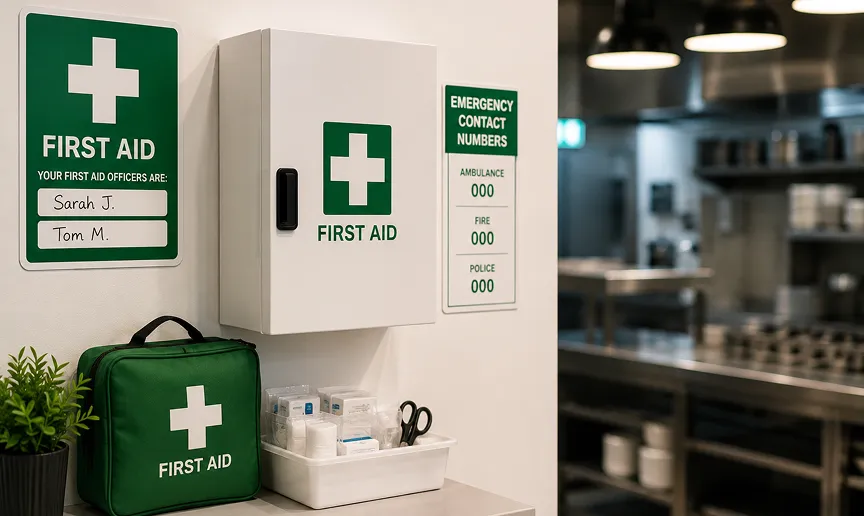
Seek or accept first aid immediately. Do not continue working through an injury. First aid kits are located in each training area and their location is identified during your induction. If the injury requires emergency medical attention, call 000.
Notify your trainer or supervisor
Tell your trainer or placement supervisor what happened as soon as it is safe to do so. This must happen on the same day as the incident, without exception.
Complete an incident report
You or your trainer will complete a formal incident report. This is a legal requirement regardless of the apparent severity of the injury. Incident reports are used to understand what happened, prevent recurrence, and fulfil TheFCA's reporting obligations. You will be asked to provide an account of the incident as part of this process.
Follow-up care
Depending on the nature of your injury, you may be referred to additional medical support. TheFCA will advise you on any follow-up steps required. If your injury affects your capacity to participate in scheduled training, contact Student Services to discuss the impact on your enrollment.
Workers compensation
Students engaged in approved training activities at TheFCA premises and on industry placement may be covered under TheFCA's workers compensation insurance for injuries sustained in those activities. Coverage specifics and claim processes will be explained to you at the time of an incident. For international students, your OSHC policy also provides access to medical treatment — however OSHC and workers compensation are separate and serve different purposes.
Personal protective equipment
PPE at TheFCA is not optional. The following requirements apply to all students in practical training sessions and on industry placement unless a specific exemption has been formally approved.
TheFCA uniform
Your full uniform must be worn at all times during practical sessions. This includes a chef's jacket or hospitality uniform as applicable to your qualification. Uniforms must be clean, undamaged, and worn as designed. Loose clothing, dangling accessories, or modified uniforms that reduce protection are not permitted.
Safety footwear
Closed-toe, non-slip safety footwear is mandatory in all kitchen and food production environments. Open-toed shoes, sandals, thongs, and non-slip-soled footwear are not permitted under any circumstances.
Hair and jewellery
Hair must be tied back or covered when working in kitchen environments. This is both a food safety requirement and a WHS requirement. Jewellery that poses an entanglement or contamination risk must be removed or securely covered before entering practical areas.
Heat and cut protection
Appropriate oven mitts, pot holders, and cut-resistant gloves are provided in TheFCA's training kitchens for tasks requiring them. Their use is directed by your trainer and must be followed
Chemical handling
Cleaning and sanitising chemicals used in kitchen environments are classified as hazardous substances. Safety Data Sheets (SDS) for all chemicals used at TheFCA are available in each practical area. You will be trained on the correct handling, use, and storage of chemicals as part of your WHS induction. Gloves and other PPE must be worn when handling chemicals as directed.
Manual handling
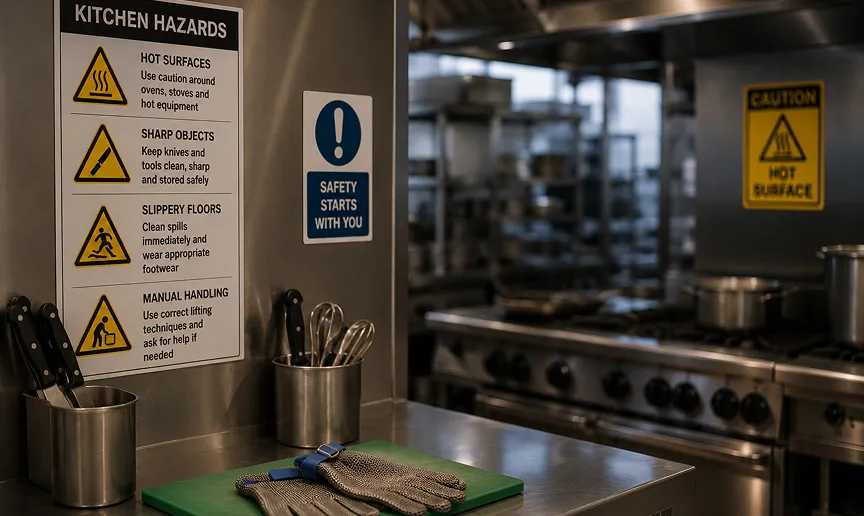
Hospitality environments involve significant manual handling — lifting, carrying, pushing, and pulling heavy items including pots, trays, boxes of produce, and equipment. Injuries from incorrect manual handling are among the most common in the industry and are largely preventable.
At TheFCA, you will be instructed in safe manual handling techniques as part of your practical training.
Key principles include:
Planning the lift before you begin — assess the load, the path, and whether assistance is needed.
Using correct technique — bend at the knees, keep the load close to your body, avoid twisting your spine.
Asking for help — do not attempt to lift or move a load that is too heavy or awkward to manage safely alone.
Using equipment — trolleys, carts, and other handling aids are available and should be used for appropriate loads.
If a task requires manual handling that you believe poses a risk to your safety, raise it with your trainer before proceeding.
Safety
Food safety and hazardous substances
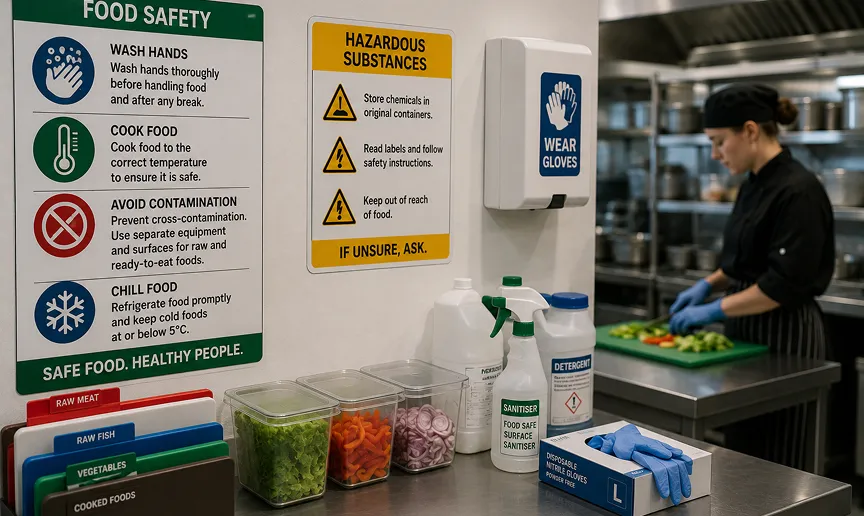
Food safety and WHS are closely connected in a professional kitchen environment. The following principles apply to your training at TheFCA.
Allergen handling
The mishandling of allergens poses a direct risk of serious harm to others. TheFCA's training kitchens follow strict allergen management procedures. You are required to follow these procedures at all times and to declare any known personal food allergies to your trainer before commencing practical work.
Chemical safety
Cleaning chemicals, sanitisers, and other hazardous substances used in kitchen maintenance are stored in designated areas, labelled, and accompanied by Safety Data Sheets. You must not use, mix, or dispose of chemicals in ways that are not directed by your trainer or the relevant SDS.
Hygiene and cross-contamination
Personal hygiene practices — including handwashing, glove use, and conduct when unwell — are both food safety requirements and direct WHS obligations. You must not attend practical training if you are experiencing symptoms of illness that could be transmitted through food handling.
Psychological safety and wellbeing
TheFCA is committed to a training environment that is psychologically safe as well as physically safe. The hospitality industry has historically carried a culture that normalises high-pressure behaviour, excessive workloads, and the dismissal of emotional and psychological harm. That culture causes real damage to real people, and it is not replicated at TheFCA.
Psychological hazards are recognised WHS hazards under the OHS Act. They include bullying, harassment, discrimination, unreasonable workload demands, and exposure to traumatic events.
Bullying
Repeated, unreasonable behaviour directed at a person or group that creates a risk to health and safety constitutes workplace bullying. This applies equally to student-to-student, trainer-to-student, and supervisor-to-student conduct. Bullying will not be tolerated in any TheFCA environment and will be addressed through TheFCA's Complaints and Discipline process.
Harassment and discrimination
Conduct that is offensive, belittling, or humiliating on the basis of a person's background, identity, gender, sexuality, religion, language, or any other protected attribute is unacceptable and may constitute both a WHS breach and a breach of Australian anti-discrimination law.
Industry placement conduct
TheFCA expects placement venues to provide a psychologically safe environment for our students. If you experience bullying, harassment, discrimination, or any conduct that causes you distress during your placement, you are encouraged to report it to your TheFCA placement coordinator immediately. You will be supported, and your placement may be relocated if the situation is not resolved satisfactorily.
Mental health and stress
The demands of vocational training — particularly in practical, high-pressure environments — can be stressful. TheFCA's Student Services team can connect you with wellbeing support, counselling referrals, and practical assistance if you are experiencing difficulty. You do not need to reach a crisis point before seeking help.
Emergency procedures
TheFCA conducts regular emergency drills at all training sites. Participation is mandatory. Emergency procedures are communicated during your induction and are displayed in each training area.
In the event of a fire or evacuation
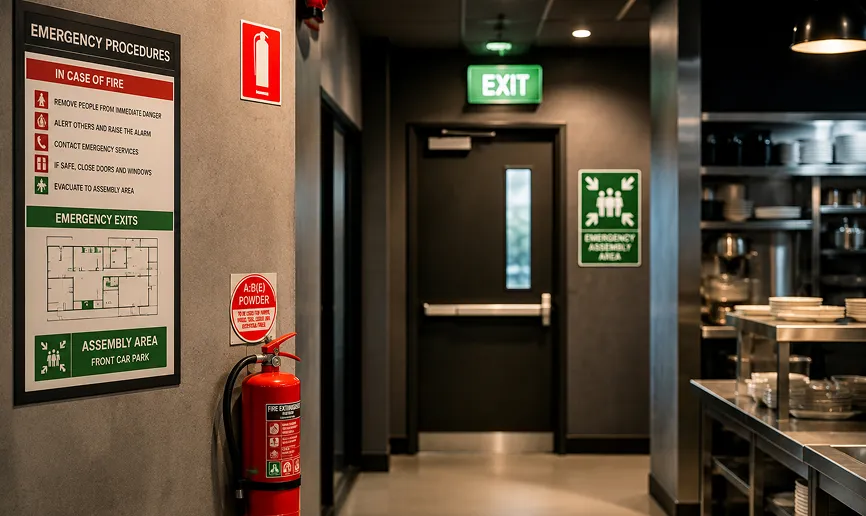
Activate the nearest fire alarm if safe to do so. Evacuate immediately via the nearest marked exit. Proceed to the designated assembly area for your site — this is identified during your induction. Do not re-enter the building until an authorised person confirms it is safe.
In the event of a medical emergency
Call 000 immediately for serious injuries or medical events. Notify your trainer or a TheFCA staff member. Do not move an injured person unless they are in immediate danger. First aid officers are trained to manage the scene until emergency services arrive.
In the event of a hazardous substance spill
Do not attempt to clean up a significant chemical spill without appropriate training and PPE. Notify your trainer immediately and evacuate the area if directed. Refer to the Safety Data Sheet for the relevant substance.
WHS on industry placement
Your WHS obligations and protections apply equally when you are on industry placement at a host venue. Before your placement commences, you will receive a placement-specific WHS briefing from TheFCA. Your host venue will also conduct a site induction covering their specific procedures, equipment, and emergency arrangements.
During placement, your primary point of contact for WHS matters is your host venue supervisor. For issues that cannot be resolved at the venue level — or for concerns about the venue's WHS standards — contact your TheFCA placement coordinator directly.
If you are ever asked to perform a task during placement that you believe is unsafe, you have the right to decline that task and to seek guidance. This right is protected by law. You will not face academic or enrollment consequences for refusing an unsafe task.

Consultation and continuous improvement
HAZARD COMMUNICATION
You will be informed about hazards identified in your training environment and the controls put in place to manage them safely.
STUDENT FEEDBACK
Your feedback on WHS matters is actively sought through student surveys, trainer check-ins, and direct reporting channels.
INVESTIGATION & OUTCOMES
WHS concerns you raise will be investigated, and you will be advised of the outcome.
CONTINUOUS IMPROVEMENT
TheFCA reviews its WHS practices regularly and updates procedures in response to incidents, near-misses, regulatory changes, and student feedback.
SAFETY SUGGESTIONS
If you have a suggestion for improving safety in your training environment, raise it with your trainer or submit it in writing to the WHS coordinator. All suggestions are considered.
Key contacts
Contact our Admissions team to arrange a personalised tour at a time that suits you. We would rather you come and see us than make a decision based on a web page.


